Product operations
How small teams prioritize customer feature requests
A practical framework for small SaaS teams to use customer requests and votes without letting the loudest idea dictate the roadmap.
Treat requests as evidence, not commands
A request board is a source of customer evidence. It shows what people struggle with, what language they use, and which needs recur. It is not a contract to build the most-upvoted item next.
Small teams need this distinction because their advantage is focus. Building every plausible request creates a broad, difficult product. The aim is to identify the requests that reinforce the product’s direction and solve meaningful customer problems.
Combine four signals before deciding
Use votes as one signal, then compare them with customer fit, severity, strategic direction, and effort. A low-vote report of a broken core workflow deserves more urgency than a popular cosmetic preference. A recurring request from customers you want to serve may deserve more investigation than a one-off suggestion from an audience outside your focus.
- Reach: How many people experience this need or would benefit from it?
- Intensity: Does it block work, create risk, or merely improve convenience?
- Fit: Does solving it reinforce the customer and product you are building for?
- Effort: What is the smallest useful version, and what does it displace?
Keep similar requests together
Duplicate requests hide the signal you are trying to measure. When two requests describe the same underlying outcome, merge them or guide customers to vote on the existing one. Preserve useful context when you do: the wording can reveal different use cases even when the desired feature is shared.
A simple duplicate check during submission helps customers find an existing idea before they create a new one. That is usually better for them too, because their vote joins a visible conversation instead of disappearing into a separate card.
Use statuses to reduce uncertainty
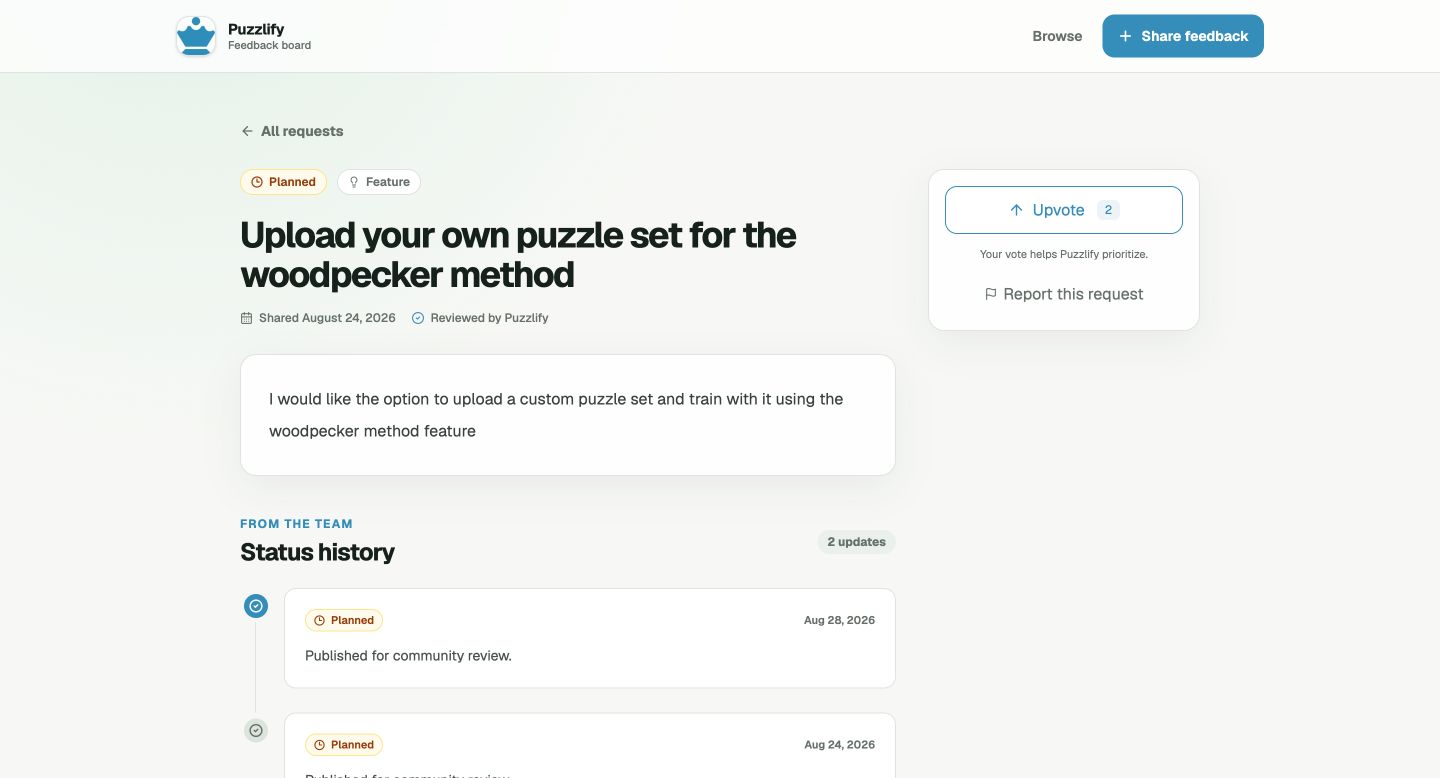
Public status updates are a lightweight way to close the loop. Use a small vocabulary, such as Open, Planned, and In progress, and define it internally. Open means it is being considered, not that it is on a deadline. Planned means you have made a directional commitment but can still be honest about timing.
Avoid status changes that sound more certain than your roadmap. Customers generally handle a thoughtful no better than silence or a vague promise. If a request does not fit, you can leave it open, explain the constraint when appropriate, or mark it hidden if it is spam or unsuitable for the public board.
Set a cadence your team can keep
For an early team, a weekly 20-minute review is usually more valuable than a complex scoring system. Scan new requests, resolve duplicates, tag urgent bugs, and choose which status changes are worth sharing. Review the highest-signal themes before planning work, not only at the end of a quarter.
The process should make decision-making calmer. If a board creates more pressure than clarity, reduce the number of statuses, improve the submission prompt, and restate the product direction. The system should serve your roadmap—not replace it.
A focused place to start
Turn feedback into a clear shared loop.
Simple Feature Board gives small SaaS teams a hosted board, embeddable widget, moderation controls, and public status updates—with straightforward pricing.
Create your free boardRelated product pages